Every competitor ad, public and free
Meta is legally required to make every active ad on Facebook and Instagram publicly searchable. That means every dropshipper, every brand and every soon-to-be competitor of yours is publishing their entire paid strategy in the open, and almost nobody bothers to read it. The Ad Library costs nothing, needs no account, and answers the single most expensive question in this business: how crowded is the market I am about to enter?
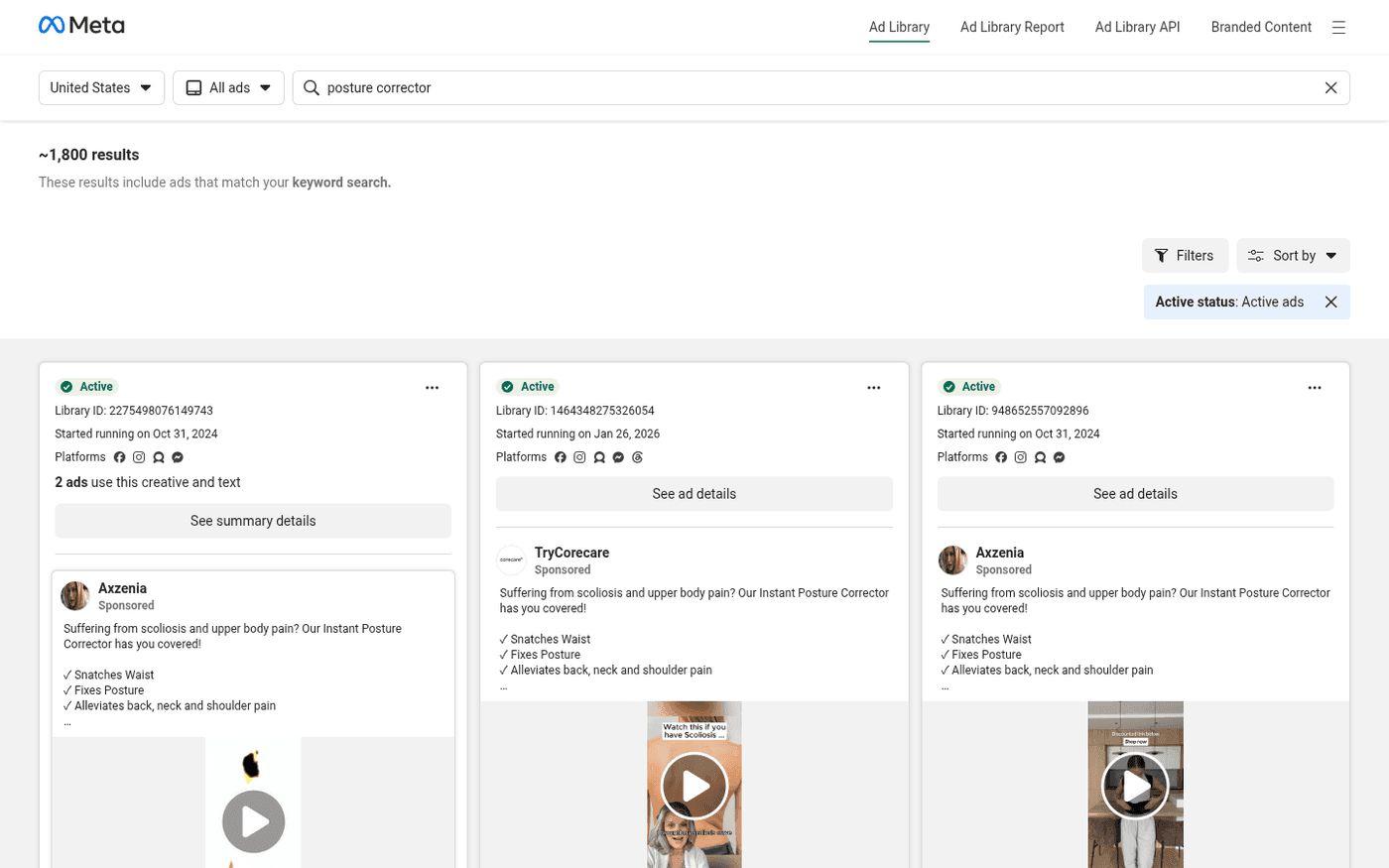
Look at what the screenshot actually tells you. Three different stores are running the exact same hook ("Suffering from scoliosis and upper body pain?"), the same checkmark bullets, the same creative format. When advertisers converge on identical copy, the market has stopped rewarding creativity and started rewarding budgets. That is your cue to find a different angle or a different product.
My five-minute reading routine
- 1
Search the product keyword, filter to active ads only
Dead ads are history lessons. Active ads are the current battlefield. Set the country to your target market, not worldwide.
- 2
Count distinct advertisers on the first two pages
Under 5: possible gap. 5 to 20: normal competition. 20+: enter only with a genuinely different angle. This is the same threshold I use in my pre-spend checklist.
- 3
Check the "Started running" dates
An ad running for 60+ days is profitable, full stop. Nobody pays Meta for two months out of stubbornness. A wall of ads all started within the last two weeks means a wave of copycats just arrived.
- 4
Look for the copy convergence
Same hooks, same bullets, same emoji patterns across stores means everyone is copying one winning ad. The original advertiser is scaling; the copycats are donating to Meta.
- 5
Click through to their stores
The ad is half the strategy. The landing page, the price point and the bundle structure are the other half, and they are one click away.
Long-running ads are the real gold
Sort mentally by ad age, not by how good the creative looks. A boring ad that has run for 90 days beats a beautiful ad that launched yesterday. Age equals profitability.
Pair it with demand data or it lies to you
The Ad Library shows you supply: who is spending. It says nothing about demand. Twenty advertisers on a product with exploding demand is a healthy market; five advertisers on a product with collapsing demand is five people losing money politely. So I always read the Ad Library next to the source order curve.
- Rising orders + few advertisers: the best possible signal. Move fast.
- Rising orders + many advertisers: enterable, but your creative angle decides everything.
- Falling orders + many advertisers: the market is eating itself. Watch, do not enter.
- Falling orders + few advertisers: the wave is over and the smart money already left.
In Majorka I keep the order curve open in one tab and the Ad Library in another. Demand on the left, competition on the right, decision in the middle. Five minutes, zero dollars, and you know more than the person about to spend $500 finding out the hard way.
“The Ad Library tells you who is fighting. The order curve tells you if the prize is worth the fight.”

Written by
MaximusFounder of Majorka
Built Majorka after years of running his own stores and being tired of guessing. Every post here comes from real tests, real ad spend, and real mistakes he paid for so you do not have to.
Share article
Put this playbook to work in 30 seconds
Paste any AliExpress link and see the order curve, velocity, and verdict for yourself. Plans from $39/mo.
See it in Majorka4.9/5 from 1,632 sellers
Orders · 24 wks
Scale23,491