Every store leaks
Here's something that took me embarrassingly long to internalize: you almost never need to guess what a competitor is doing. Their best sellers are sorted on their own site. Their ad angles are in public libraries. Their supplier is usually findable from a product photo. The information isn't hidden, it's just scattered, and most people can't be bothered to collect it.
I run this routine on maybe five stores a week. It's the same 20 minutes every time, in the same order, because the order matters, each step tells you what to look for in the next one.
The routine, in order
- 1
Sort their catalog by best selling
Add /collections/all?sort_by=best-selling to almost any Shopify store URL. That's their revenue ranking, published by their own theme. Screenshot it, you'll want to compare in a month.
- 2
Check what they added recently
Sort by newest instead. A store adding ten products a week is testing (weak conviction). A store that added two products in three months is scaling what works (strong conviction). Copy the second store, not the first.
- 3
Pull their ads
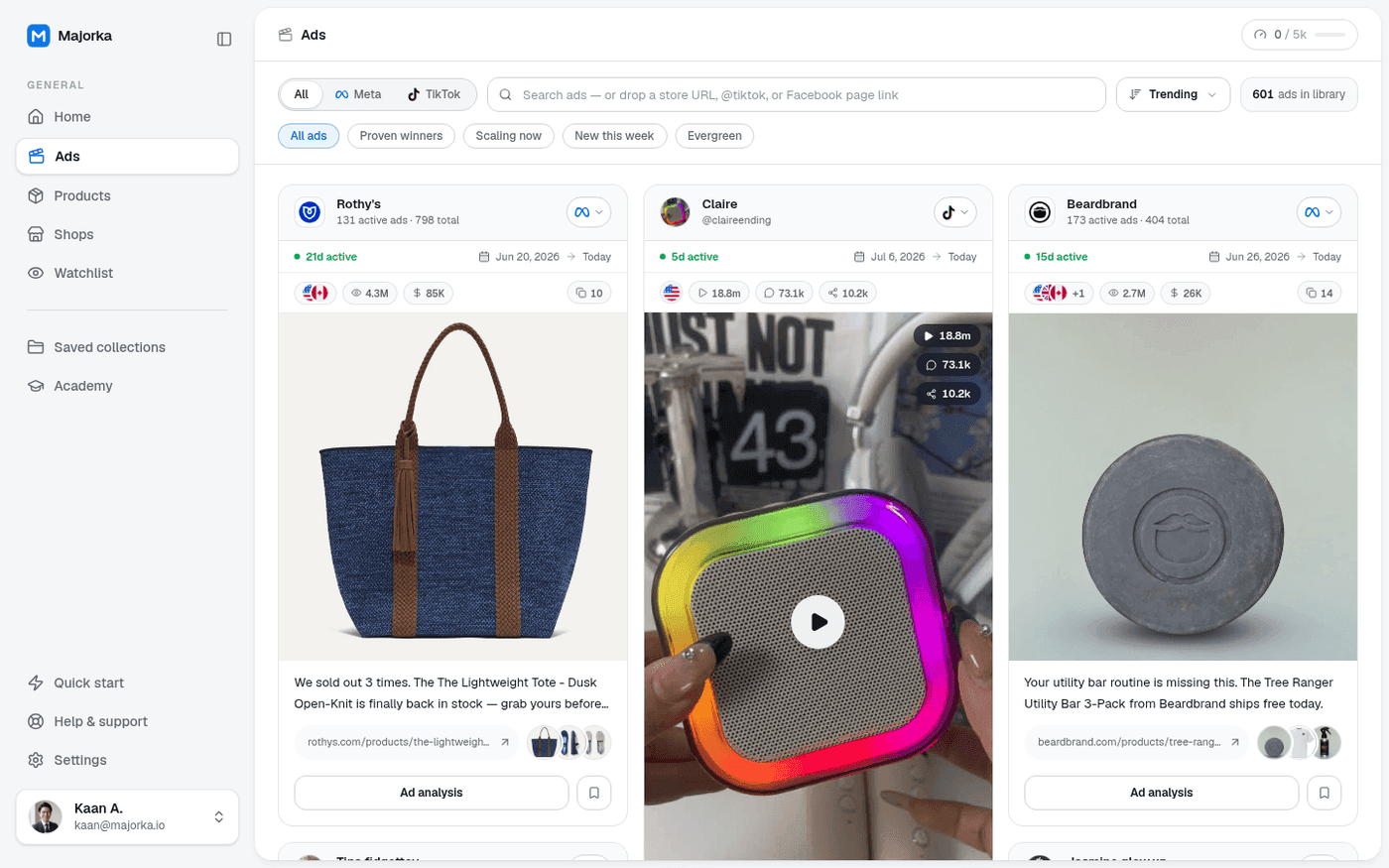
Search the store name in the ad libraries, or paste their store URL into Majorka's Ads tab and see every active Meta and TikTok ad at once. Note which products get ad spend. Spend follows winners.
- 4
Check how long the winning ad has been running
An ad active for 60+ days is profitable, full stop, nobody funds a loser for two months. That product-plus-angle combination is proven. Ninety days? That's a pillar of their business.
- 5
Trace the product to its source
Reverse image search the product photo, find the AliExpress listing, and run the analysis. Now you know their approximate cost, every variant's sales, and whether the underlying demand is still rising or they're riding a fading wave.
- 6
Write down the gap
One sentence: 'They own X, they're ignoring Y.' Wrong variant, ignored country, missing angle, weak bundle. If you can't write the sentence, there's no entry, move on to the next store.
Reading between the lines
The routine gives you facts. The judgment layer is where it pays. A few patterns I've learned to trust after a few hundred of these:
- A store running the same creative concept re-shot three different ways isn't confused, they found an angle that works and they're squeezing it. Study the concept, not any single video.
- A best-seller list dominated by one product means fragility, not strength. If you can find their supplier and their angle, you can attack the whole business through one product.
- Prices ending in .97 or .95 with aggressive countdown timers usually mean thin margins and paid-traffic dependency. They can't survive a price war. That's useful to know before you start one.
- If their winning product's source curve is declining while their ads still run, you're watching a store in its decay phase. Don't copy them into the grave.
Research them, don’t become them
The goal is finding the gap they left, not producing a worse copy of their store. Cloning gets you their market position minus their data advantage minus their creative testing. You lose that fight by default.
“Amateurs copy the store. Professionals copy the homework.”

Written by
MaximusFounder of Majorka
Built Majorka after years of running his own stores and being tired of guessing. Every post here comes from real tests, real ad spend, and real mistakes he paid for so you do not have to.
Share article
Put this playbook to work in 30 seconds
Paste any AliExpress link and see the order curve, velocity, and verdict for yourself. Plans from $39/mo.
See it in Majorka4.9/5 from 1,632 sellers
Orders · 24 wks
Scale23,491