[ Product verdict ]
A 0 to 100 verdict that shows its working
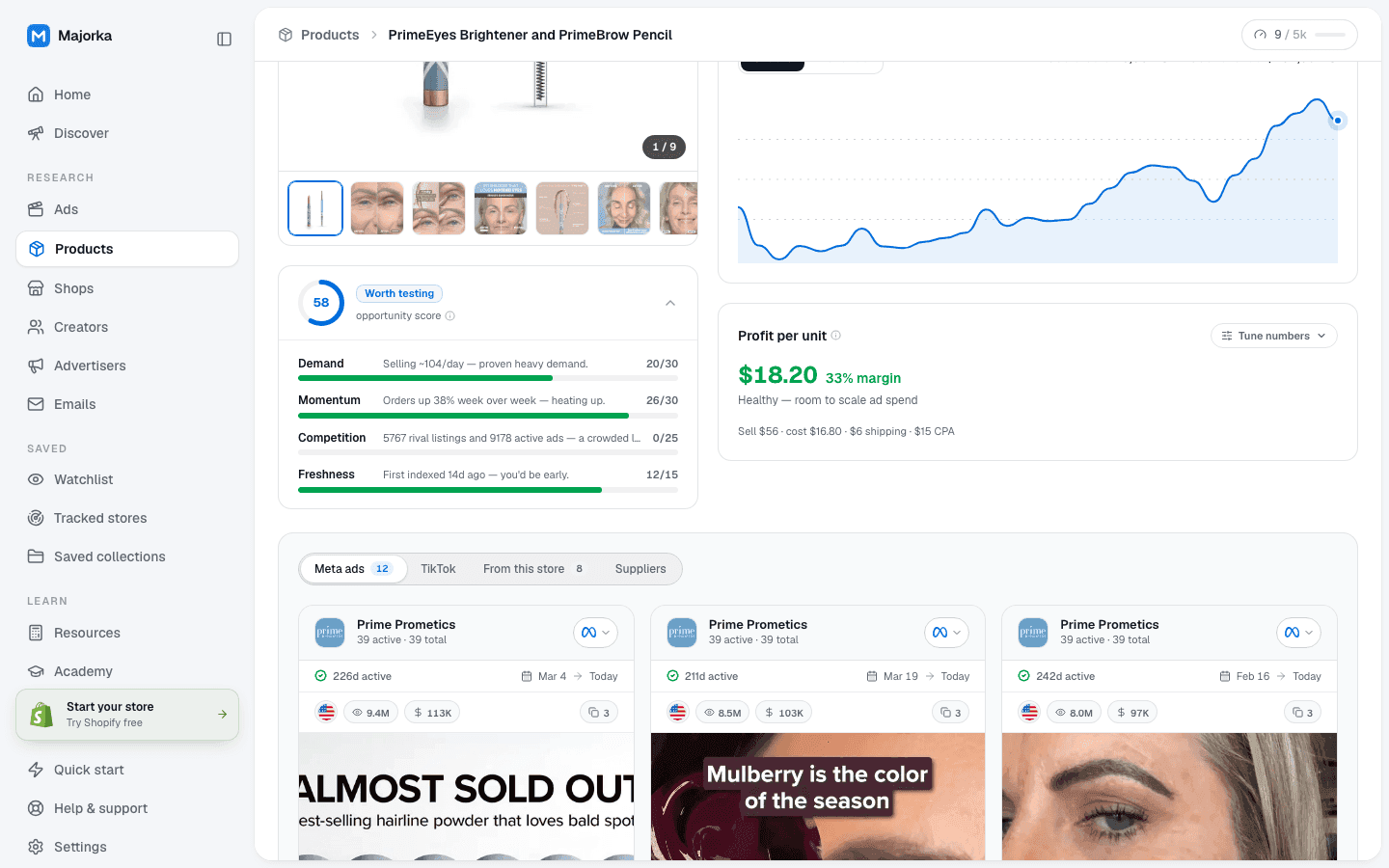
Demand, momentum, competition and freshness, each scored and each with a one-line reason. The label says Enter now, Worth testing, Crowded or Saturated; the factors say why.
[ Core capabilities ]
What Product verdict does
Demand 0 to 30, Momentum 0 to 30, Competition 0 to 25 (inverted: fewer rivals score higher) and Freshness 0 to 15, summing to 100.
How each factor is computed
- Demand
- Average orders per day over the last 7 days of samples, on a log scale: 50 a day is already strong
- Momentum
- Last 7 days of orders against the 7 before
- Competition
- Catalog products with the same keyword from other stores, plus active ads in the same niche, inverted
- Freshness
- Days since the product was first indexed; the early-mover window closes at 60
- Labels
- 72+ Enter now · 52+ Worth testing · 35+ Crowded, differentiate · below, Saturated / fading
[ How you use it ]
Product verdict, in four steps
- 01
Filter the catalog
Start from New winning products or Fast selling, set a price ceiling, and sort by revenue or newest. Every row shows its 30-day trend.
- 02
Open the product
The verdict ring and label sit under the images. Expand it to see the four factors, their scores out of 30, 30, 25 and 15, and the reason behind each.
- 03
Check the competition line
Rival listings and active ads in the lane are counts we hold. A zero on Competition with high Demand means a crowded lane, not a bad product.
- 04
Tune the margin
Profit per unit starts from benchmark costs for the price bracket; the sliders are yours. Then look at the ads tab for the creatives already landing on it.
[ What’s measured vs estimated ]
Every number on this surface, with where it comes from
Where there is no measurement, the product shows nothing rather than a guess. The labels below are the ones on screen.
- ModelledComputed from a stated method; carries an info hint.
- EstimatedDerived where the platform discloses nothing; labelled est.
- MeasuredA count or a value read from the source.
- Opportunity score (verdict)
- Scored from demand, momentum, competition and freshness; each factor is explained below the ring.
- 30d orders
- Modelled from the listing’s total sales and age, not a measured daily count.
- 30d revenue
- Sampled daily orders multiplied by the current listed price.
- Daily velocity (7d)
- Average orders per day across the last 7 days of samples.
- Rival listings, active ads in lane
- Counts over the catalog and the ads index.
- First indexed
- The day Majorka first saw the product.
- Price, variants, images, URL, store
- Real listing data from the public product feed or the marketplace page.
- Profit per unit
- Benchmark costs for the price bracket; tune the sliders to your own numbers.
[ Keep going ]
Related features and free tools
- FeatureAds libraryEvery Meta ad links to its own Ad Library page. Days running, duplicates and the rank by reach sit on the card, so you read a winner from evidence, not from a badge.Open
- FeatureShopsA directory of Shopify stores built from the Meta ads they actually run. Sort by active ads, 30-day growth, reach or catalog size, cut it with the segments below, and open any store for the full picture.Open
- Free toolBreak-even ROAS calculatorThe return your ads must hit before an order makes money.Open
- Free toolProfit margin calculatorMargin, markup and the price that hits your target.Open
They are modelled, and every one carries an info glyph that says how. Shopify does not expose order counts, so daily orders are modelled from the listing’s total sales and age, and revenue is that figure times the listed price. Price, variants, images and the store are real listing data.
Because the question is whether you can enter. A wide-open lane scores the full 25; a lane with thousands of rival listings and ads scores near zero, and the reason line says so in plain words.
A total between 52 and 71. Enter now starts at 72, Crowded at 35, and anything below that is labelled Saturated or fading. A product whose orders are clearly falling is capped at 40 regardless of its other factors.
Shopify public product feeds from the stores we index and AliExpress listings read from search pages, on a ten-minute ingest cycle. Junk listings such as gift cards and warranties are rejected.
Yes. Product of the day publishes one complete analysis free every day with the same verdict card.